
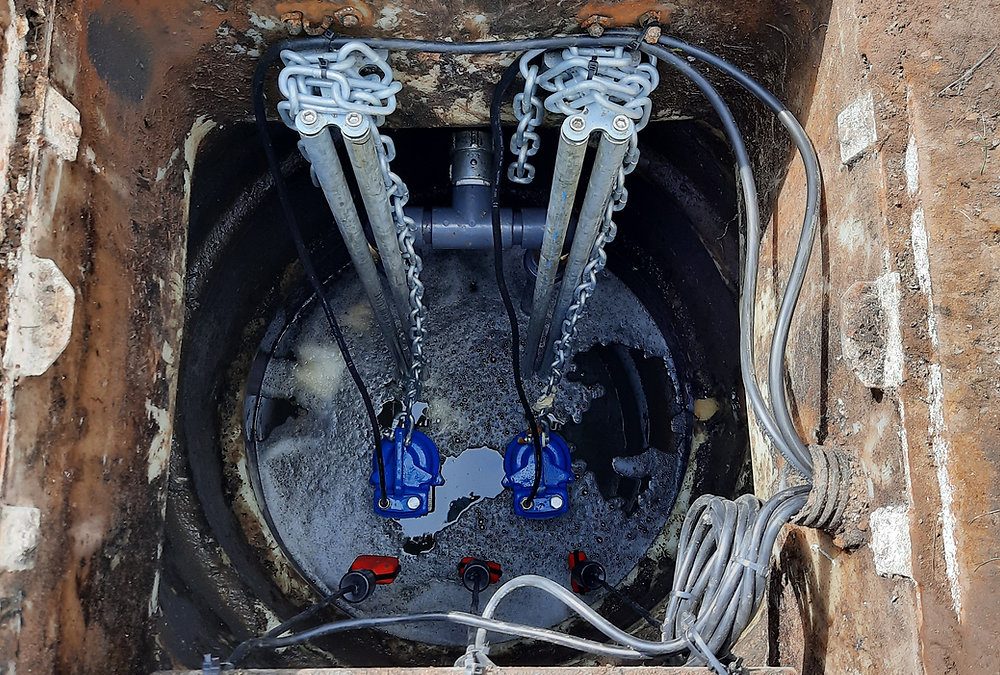
🏗️💧 LIFT STATIONS – DO YOU REALLY KNOW HOW THEY WORK?
If you’re working in MEP engineering and still don’t know the main components of Sewage and Stormwater Lift Stations, you’re missing an essential part of plumbing engineering!
Let’s take a quick engineering tour inside a Lift Station and understand its major components, functions, and operating principles. 👷♂️
🔹 1. WHY DO WE NEED A LIFT STATION?
The main purpose of a Lift Station is to collect wastewater or stormwater from residential, commercial, industrial, or other developments and pump it to a higher elevation, allowing discharge into the municipal drainage network.
Lift Stations are typically required when the drainage system cannot discharge by gravity due to elevation differences.
The collected water flows into a chamber called the Wet Well, where submersible pumps lift it to the required discharge level.
🔹 2. BASKET SCREEN
Before wastewater enters the Wet Well, large debris and solid materials must be intercepted to prevent pump blockage or damage.
This is typically achieved using a Basket Screen, which captures large solids and allows wastewater to pass through.
The screen must be periodically lifted and cleaned using a suitable lifting arrangement, such as:
- Manual or Electric Hoist
- Wire Rope and Lifting Mechanism
- Other suitable lifting equipment
The arrangement depends on the station design and maintenance requirements.
🔹 3. OIL & SAND SEPARATOR
In certain stormwater drainage applications, particularly in areas exposed to oil contamination and sediment accumulation, such as parking areas and vehicle service facilities, preliminary treatment may be required.
An Oil & Sand Separator helps remove oil, grease, and sediment before stormwater enters the pumping station.
Its requirement depends on the nature of the collected water, project specifications, and local authority regulations.
🔹 4. PENSTOCK GATE
A Penstock Gate may be installed at the inlet of the Lift Station.
Its primary purpose is to isolate incoming flow during:
- Maintenance activities
- Equipment replacement
- Emergency situations
- Wet Well inspection and cleaning
This component plays an important role in ensuring safe operation and maintenance.
🔹 5. SUBMERSIBLE PUMPS – THE HEART OF THE STATION ❤️
Submersible pumps are the main operating equipment responsible for lifting wastewater or stormwater to the required discharge elevation.
Depending on the station design, pumps are generally arranged as:
- Duty Pumps: Responsible for normal operation.
- Standby Pumps: Provide backup capacity when required.
However, pump operation is not random!
It follows a carefully designed Control Philosophy, typically incorporating:
✅ Float Switches
✅ Level Transmitters
✅ Control Panel / PLC
The control system manages:
- Pump Start and Stop Levels
- Duty/Standby Alternation
- High-Level and Low-Level Alarms
- Pump Failure and Emergency Conditions
- Automatic Pump Sequencing
A properly designed control system improves operational reliability and reduces unnecessary pump cycling.
🔹 6. VALVE CHAMBER & FORCE MAIN
After leaving the pumps, wastewater enters the pressurized discharge pipeline, commonly known as the Force Main.
The discharge arrangement includes several important mechanical components, often installed inside a separate Valve Chamber for easy access and maintenance.
Typical components include:
✅ Gate Valves / Isolation Valves
✅ Non-Return Valves (Check Valves)
✅ Pressure Gauges / Pressure Transmitters
✅ Flow Meters
✅ Dismantling Joints
Each component serves a specific purpose in system operation, maintenance, isolation, and performance monitoring.
Proper valve arrangement and accessibility are essential considerations during the shop drawing stage.
🔹 7. SURGE PROTECTION SYSTEM
In some Lift Stations, particularly those connected to long Force Mains, sudden changes in water velocity can generate significant pressure transients.
These conditions may occur due to:
- Sudden Pump Shutdown
- Power Failure
- Rapid Valve Closure
- Changes in Pump Operating Conditions
Such events can result in Water Hammer, potentially damaging pipelines, valves, and pumping equipment.
Therefore, a Surge Analysis may be required to evaluate the system response.
Depending on the results, suitable protection measures may include:
✅ Surge Vessels
✅ Air/Vacuum Valves
✅ Controlled Valve Operation
✅ Other Surge Mitigation Devices
The final protection arrangement must be based on the hydraulic analysis and project requirements.
⚙️ FINAL THOUGHTS
A Lift Station is much more than a Wet Well and two pumps!
It is a complete engineering system integrating:
🏗️ Civil & Structural Works
🔧 Mechanical Systems
⚡ Electrical Systems
🖥️ Instrumentation & Control Systems
Every component must be carefully designed, selected, and coordinated to ensure safe, efficient, and reliable operation.
🎯 The real engineering challenge is not simply knowing the names of the components. It is understanding WHY each component is required, HOW it is selected, and WHAT impact it has on the overall system performance.
🚀 WANT TO LEARN MORE?
This is exactly what we focus on in our SHOPDRAWING MATRIX COURSE by Fire Matrix.
From understanding engineering design principles and equipment selection to preparing professional shop drawings, builder work drawings, and coordinating with other disciplines.
Move beyond simply drafting drawings — understand the engineering behind every detail!
📚 Request your course today!
🌐 Website: www.fire-matrix.org
📱 WhatsApp: +201025012944
👷♂️ Eng. Ali Hassan (PHF Engineer)
10+ Years of Experience in MEP Engineering
#FireMatrix #ShopdrawingMatrix #LiftStation #PumpStation #MEP #PlumbingEngineering #Drainage #Wastewater #Stormwater #EngineeringDesign #ShopDrawings #Construction #MechanicalEngineering